Emperor penguin at serious threat of extinction attributable to local weather change
Warning: Undefined variable $post_id in /home/webpages/lima-city/booktips/wordpress_de-2022-03-17-33f52d/wp-content/themes/fast-press/single.php on line 26
2022-05-08 18:54:19
#Emperor #penguin #threat #extinction #due #climate #change
The emperor penguin is at extreme threat of extinction within the next 30 to 40 years as a result of climate change, in accordance with analysis by the Argentine Antarctic Institute (IAA).
Key points:Penguin chicks succumb to freezing or drowning when exposed to the ocean before they develop their waterproof plumageIf nothing modifications, many colonies will disappear in the next 30 to 40 yearsTourist and fishing exercise additionally harms the penguins, disrupting the food cycleThe emperor, the world's largest penguin and one in all solely two penguin species endemic to Antarctica, provides delivery during the Antarctic winter and requires solid sea ice from April through to December to nest fledgling chicks.
If the ocean freezes later or melts prematurely, the emperor family can not full its reproductive cycle.
"If the water reaches the new child penguins, which are not ready to swim and do not need waterproof plumage, they die of the chilly and drown," stated biologist Marcela Libertelli, who has studied 15,000 penguins across two colonies in Antarctica at the IAA.
This has occurred on the Halley Bay colony within the Weddell Sea, the second-largest Emperor penguin colony, where for 3 years all the chicks died.
Each August, in the midst of the southern hemisphere winter, Dr Libertelli and different scientists at Argentina's Marambio Base in Antarctica journey 65 km each day by motorbike in temperatures as low as -40 levels Celsius to achieve the nearest Emperor penguin colony.
Once there, they rely, weigh, and measure the chicks, gather geographical coordinates, and take blood samples. Additionally they conduct aerial analysis.
Every August, researchers from Argentina's Antarctic Institute travel to Halley Bay to study the colony's chicks.(British Antarctic Survey: Peter Fretwell)The scientists' findings point to a grim future for the species if climate change isn't mitigated.
"[Climate] projections counsel that the colonies that are located between latitudes 60 and 70 levels [south] will disappear within the subsequent few many years; that is, within the next 30, 40 years," Dr Libertelli mentioned.
The emperor's unique options embrace the longest reproductive cycle amongst penguins.
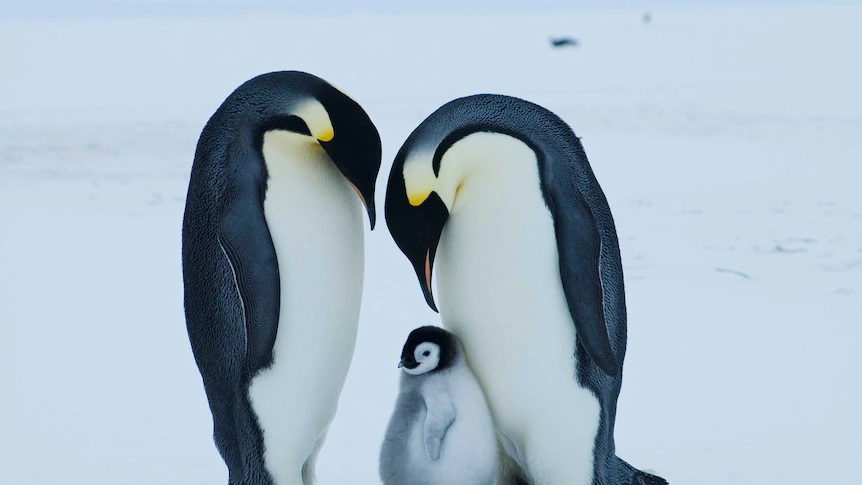
After a chick is born, one father or mother continues carrying it between its legs for warmth till it develops its last plumage.
"The disappearance of any species is a tragedy for the planet. Whether or not small or giant, plant or animal — it does not matter. It is a loss for biodiversity," Dr Libertelli said.
The emperor penguin's disappearance might have a dramatic affect all through Antarctica, an extreme surroundings where meals chains have fewer members and fewer hyperlinks, Dr Libertelli said.
In early April, the World Meteorological Group warned of "more and more extreme temperatures coupled with unusual rainfall and ice melting in Antarctica" — a "worrying pattern", said Dr Libertelli, with Antarctic ice sheets depleting since at least 1999.
The rise of tourism and fishing in Antarctica have also put the emperor's future at risk by affecting krill, one of many fundamental sources of food for penguins and different species.
"Vacationer boats usually have various damaging results on Antarctica, as do the fisheries," Dr Libertelli said.
"It can be crucial that there's better control and that we take into consideration the future."
Reuters
Quelle: www.abc.web.au