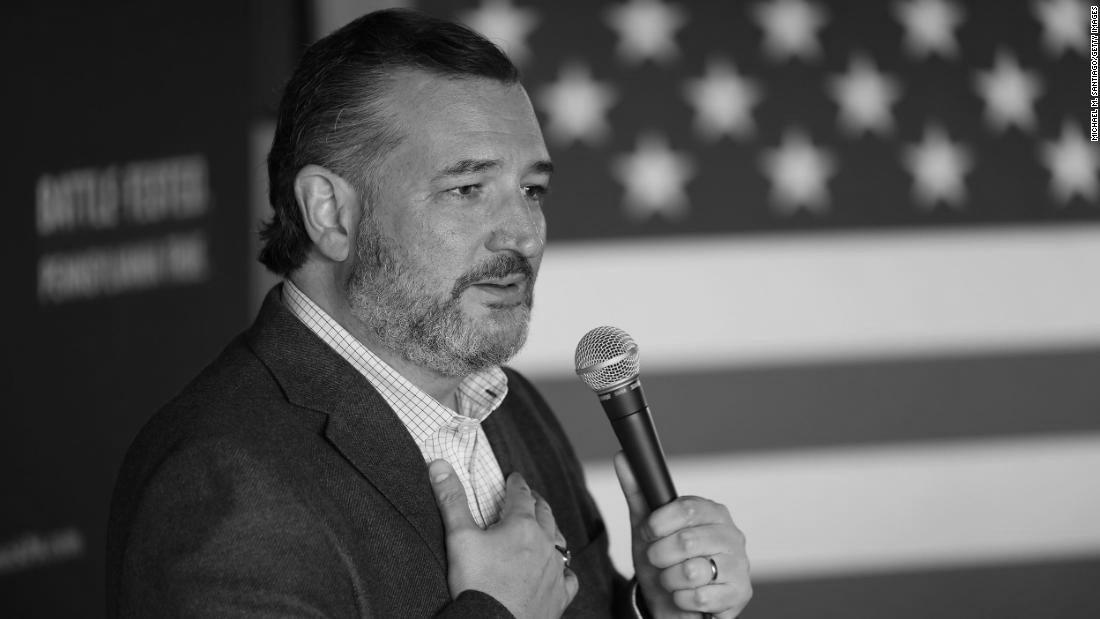
Supreme Court sides with Ted Cruz, striking down cap on use of campaign funds to repay private campaign loans
Warning: Undefined variable $post_id in /home/webpages/lima-city/booktips/wordpress_de-2022-03-17-33f52d/wp-content/themes/fast-press/single.php on line 26
2022-05-17 09:29:17
#Supreme #Court #sides #Ted #Cruz #placing #cap #campaign #funds #repay #personal #campaign #loans
The court docket stated that a federal cap on candidates using political contributions after an election to recoup personal loans made to their campaign was unconstitutional.
Chief Justice John Roberts wrote the 6-3 resolution. Justice Elena Kagan wrote the dissent for her liberal colleagues, Justice Stephen Breyer and Justice Sonia Sotomayor.
"The query is whether or not this restriction violates the First Amendment rights of candidates and their campaigns to interact in political speech," Roberts wrote. He mentioned there's "little doubt" that the regulation does burden First Modification electoral speech. "Any such regulation should be at the least justified by a permissible curiosity," he added, and the federal government had not been in a position to determine a single case of so-called "quid pro quo" corruption.
Roberts concluded that the "provision burdens core political speech without correct justification."
In her dissenting opinion, Kagan criticized the majority for ruling towards a regulation that she stated was meant to fight "a special hazard of corruption" aimed at "political contributions that can line a candidate's personal pockets."
"In putting down the legislation as we speak," she wrote, "the Court greenlights all of the sordid bargains Congress thought proper to stop. . . . In permitting these payments to go forward unrestrained, at present's choice can only convey this country's political system into further disrepute."
Indeed, she defined, "Repaying a candidate's mortgage after he has gained election cannot serve the same old purposes of a contribution: The cash comes too late to aid in any of his marketing campaign activities. All the money does is enrich the candidate personally at a time when he can return the favor -- by a vote, a contract, an appointment. It takes no political genius to see the heightened danger of corruption -- the danger of 'I'll make you richer and you'll make me richer' preparations between donors and officeholders."
In an announcement after the ruling, lawyer Charles Cooper, who represented Cruz within the case, praised the choice as a "victory for the First Amendment's assure of freedom of speech in the political process."
Within the case, campaign finance regulators on the Federal Election Commission argued that the cap -- part of the Bipartisan Campaign Reform Act of 2002 -- is necessary to protect against corruption, but a three-judge appellate court docket dominated in favor of Cruz last 12 months, holding that the loan-repayment restriction violates his First Amendment right to free speech.
At oral arguments at the Supreme Court docket, the conservative justices appeared skeptical of the government's claims that the law serves a purpose of combating corruption.
Justice Amy Coney Barrett stated that Cruz had emphasised that the after-election repayment scheme would simply replenish his coffers from cash he had loaned. "This doesn't enrich him personally, as a result of he is no better off than he was before," she mentioned, adding, "It is paying a mortgage, not lining his pockets."
And Justice Brett Kavanaugh mentioned that a candidate may feel reluctant to loan money earlier than the marketing campaign out of worry he wouldn't be capable to recoup it. "That seems to be," he stated, "a chill on your capacity to mortgage your marketing campaign cash."
Kavanaugh echoed a decrease courtroom opinion that went in favor of Cruz.
"A candidate's mortgage to his campaign is an expenditure that may be used for expressive acts," the court docket stated in an opinion written by DC Circuit Courtroom of Appeals Judge Neomi Rao. She and DC District Courtroom Judges Amit Mehta and Timothy Kelly ruled unanimously.
"Such expressive acts are burdened when a candidate is inhibited from making a private loan, or incurring one, out of concern that she might be left holding the bag on any unpaid marketing campaign debt," the ruling added.
Biden administration and marketing campaign finance watchdogs supported limits
Federal legislation allows candidate to make loans to their campaign committees without limit. Cruz was challenging a provision of the Bipartisan Campaign Reform Act of 2002 that, nevertheless, imposed a $250,000 restrict on a campaign committee's capacity to repay these loans with money contributed by donors after the election.
A day earlier than he was reelected in 2018, Cruz loaned his campaign committee $260,000, $10,000 over the limit -- laying the muse for his legal challenge to the cap. While He might have been repaid in full by campaign funds if the reimbursement occurred 20 days after the election. However Cruz let the 20-day deadline lapse so that he may set up grounds to bring the legal challenge.
Cruz's lawyers advised the Supreme Courtroom in briefs that "no First Amendment proper is more important in our constitutional democracy than the liberty of a candidate to talk with out legislative restrict on behalf of his personal candidacy."The legislation, "by considerably growing the chance that any candidate mortgage won't ever be totally repaid — forces a candidate to assume twice earlier than making those loans in the first place," Cruz's brief stated.
The Biden administration supported the bounds, saying the Cruz mortgage was made with the "sole and exclusive motivation" of triggering the lawsuit.
Deputy Solicitor Normal Malcolm L. Stewart told the justices that the regulation "imposes insubstantial burdens on the financing of electoral campaigns and it targets a follow that has important corruptive potential."
"A post-election contributor typically is aware of which candidate has received the election, and post-election contributions do not further the usual functions of donating to electoral campaigns," he said.
Marketing campaign finance watchdogs supported the cap, arguing it is essential to block undue affect by special pursuits, notably because the fundraising would occur as soon as the candidate has turn out to be a sitting member of Congress.
Noting that the provision in question was a "relatively obscure one," Dan Weiner, the director of the Elections and Government Program at the Brennan Middle for Justice at NYU Legislation, advised CNN after the ruling that "the practical implications for marketing campaign finance laws are pretty minimal."
"I think that the choice says lots about the court's broader strategy to the First Amendment and the path it is headed," mentioned Weiner, whose organization filed a friend-of-the-court temporary in supporting the limits within the case.
"It's another occasion that they're going to chip away on the restraints that our system has historically imposed on unfettered private money in campaign," Weiner added.
Chipping away at a 20-year-old marketing campaign finance legislation
Monday's ruling marks the latest erosion of the 2002 regulation -- identified by the names of its sponsors, the late Arizona Republican Sen. John McCain and former Wisconsin Sen. Russ Feingold, a Democrat. The law sought to restrict the stream of large, unregulated and often secret cash in US elections.
In recent times, nonetheless, the high court has stripped away major provisions of that legislation, most notably in its blockbuster 2010 Citizens United resolution, which allowed companies and unions to unleash unlimited amounts of money in races so long as they spent independently of the politicians they help.
In 2008, the justices additionally struck down the so-called millionaire's amendment that aimed to level the taking part in discipline when wealthy candidates financed their very own campaigns. That provision had relaxed contribution limits for opponents of self-funded candidates in an try to shut the funding hole.
In another ruling chipping away at the McCain-Feingold law, this one in 2014, the court's conservative majority struck down caps on how a lot an individual can donate in total throughout a single election cycle -- establishing one other route for large cash in elections.Towards this backdrop, advocates for limits on cash in politics mentioned the Monday's ruling was comparatively slim in scope -- leaving intact some of the remaining pillars of the legislation, together with its ban on so-called "soft-money" -- or limitless donations -- to political parties.
"It's a another blow to McCain-Feingold," Tara Malloy, a prime lawyer with the Marketing campaign Authorized Center, said of the Cruz resolution. "However it seems to be more of a loss of life by a thousand cuts as a substitute of a physique blow."
Rick Hasen, an election law knowledgeable at the College of California-Irvine's Regulation school who helps some limits on money in politics, stated Monday's opinion was a "aid" for him as a result of it did not break important new ground for a court that has dismantled other provisions of the regulation.
The justices didn't set up a new normal for what amounts to political corruption or disturb the remaining limits on campaign contributions directly to candidates, he noted in a weblog publish.But, he added in an e-mail to CNN, "the Court has shown itself to not care very a lot about the hazard of corruption, seeing defending the First Amendment rights of massive donors as extra essential."
This story has been up to date with further reaction and background information.
CNN's Tierney Sneed contributed to this report.
Quelle: www.cnn.com